Do Building Surveys Really Kill Property Sales in France?
Why finding defects doesn’t necessarily mean losing the sale
Why finding defects doesn’t necessarily mean losing the sale
I had two quite different conversations with French estate agents recently.
One reflected a view we have heard before: building surveys aren’t particularly normal in France, and introducing a surveyor into the process risks delaying things, finding problems and ultimately losing the sale.
The other agent had almost exactly the opposite opinion.
She told me that some agents were reluctant to recommend independent surveys because they were convinced the surveyor would find something that frightened the buyer away. Her view was that a good survey could actually help a sale, because a buyer who properly understands the condition of the property is more confident about proceeding.
Having worked on both sides of French property transactions, I think she has a point.
Before becoming a Chartered Building Surveyor, I worked in estate agency in France, dealing particularly with rural and historic properties. I have therefore seen transactions from both sides – trying to get a sale across the line and, subsequently, advising purchasers about what they are actually buying.
And there is one thing worth remembering:
Uncertainty can frighten a buyer far more than a known defect.
“But surveys aren’t normally done in France”
This is something international buyers hear surprisingly often.
And, to an extent, it is true. The French purchasing system doesn't have quite the same tradition of independent pre-purchase building surveys that buyers from the UK may be familiar with.
Instead, the seller provides the Dossier de Diagnostic Technique (DDT), containing the statutory diagnostic reports applicable to the property. These provide important information about matters such as energy performance, asbestos, lead, termites in relevant areas, gas and electrical installations and other prescribed risks.
They are useful documents.
But they aren't a building survey.
We covered this distinction in our recent article, Three Things International Buyers Get Wrong About Purchasing Property in France, so I won't repeat all of that here. The important point is simply that a diagnostic technician and a building surveyor are answering different questions.
A building survey looks at the property as a building.
Why is that wall cracking?
Is the roof nearing the end of its life?
Has cement pointing been used on masonry that should be allowed to breathe?
Is the dampness simply a consequence of an old building, or is defective drainage making it considerably worse?
Has that attractive converted barn actually been altered properly?
And, perhaps most importantly:
Is the thing that looks frightening actually as serious as it appears?
That last question is sometimes forgotten.
A château that buyers were frightened to buy
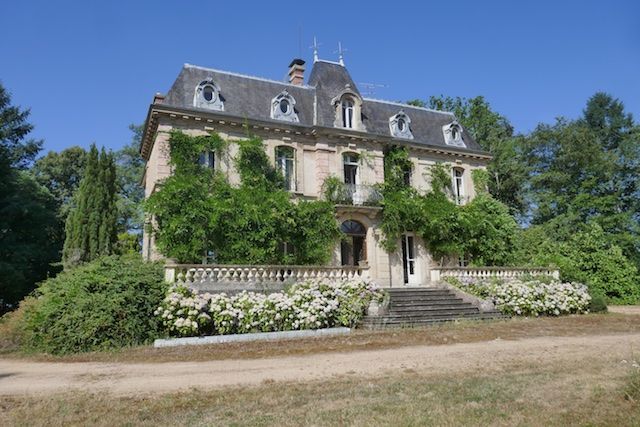
Several years ago I was asked to inspect a substantial historic property in western France.
It was an unusual instruction because my client was the seller, not a prospective purchaser.
The property had experienced previous difficulties with sales. Prospective buyers had commissioned surveys which had raised serious concerns about extensive cracking and movement. Purchases had subsequently failed to proceed.
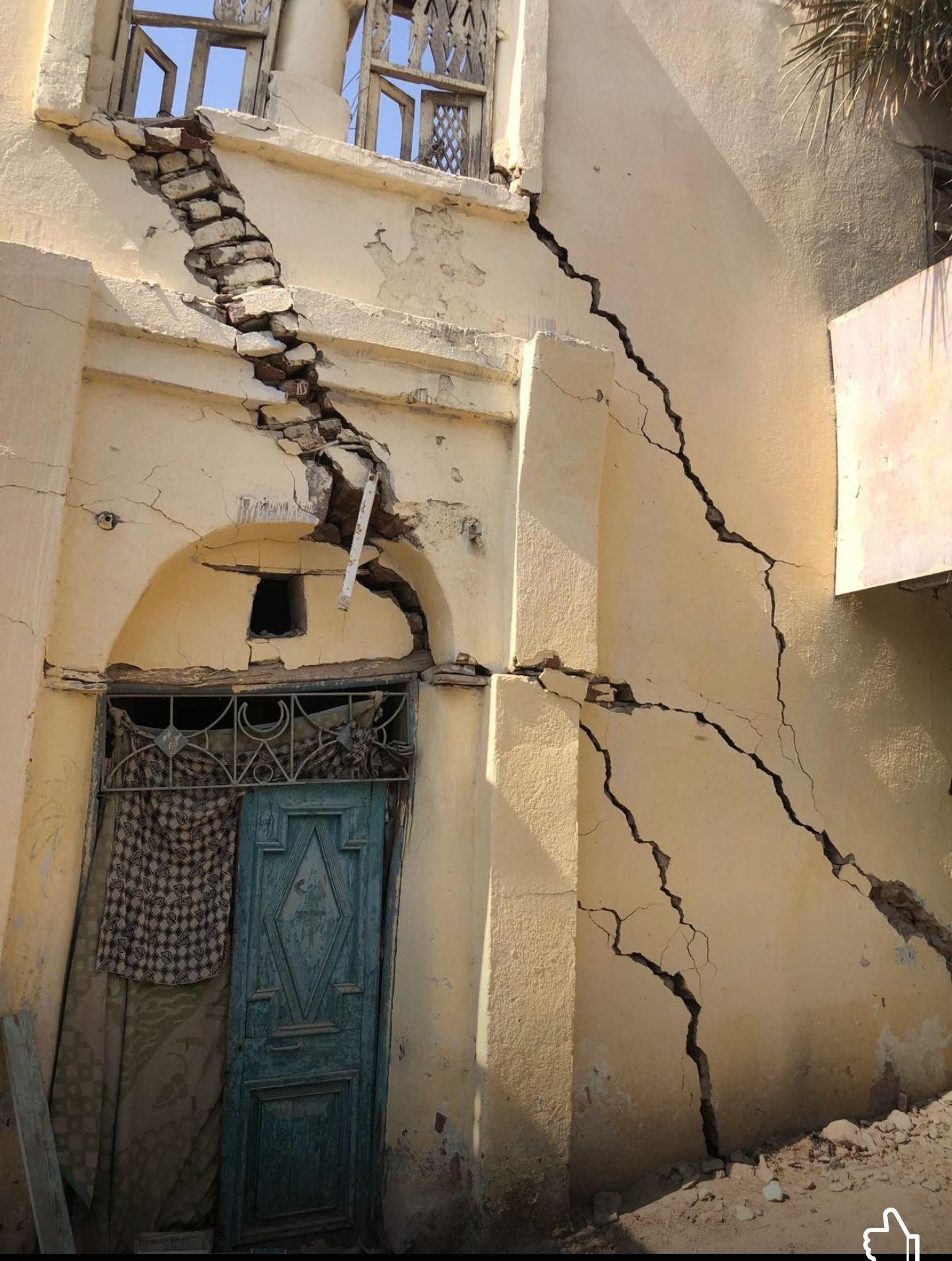
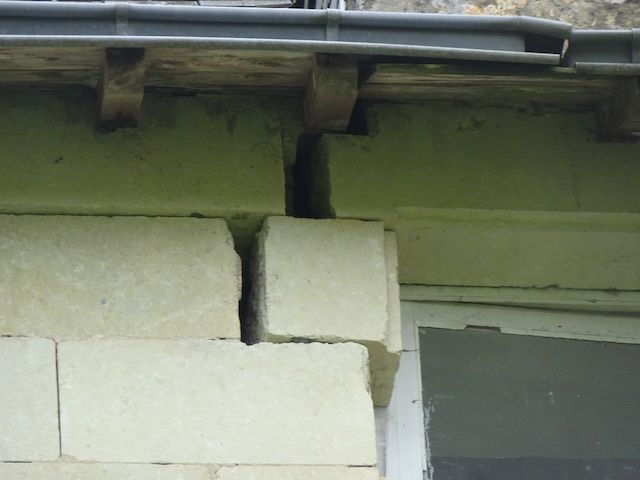
Looking at some of the cracking, it isn't difficult to understand why buyers were worried.
Would this make you walk away? Finding the crack is the easy part. The important question is why it is there.
There were open cracks through the masonry, movement around window openings and some particularly alarming defects around stone lintels.
Some of it looked dreadful.
But a building doesn't necessarily have one defect simply because the symptoms look similar.
Serious cracking doesn't automatically mean subsidence
My inspection did identify evidence of some ground movement. I considered the movement relatively minor and explored several possible contributory factors, including drainage, unusually dry conditions and the influence of a nearby tree.
Importantly, corresponding cracking wasn't evident within the cellar beneath the affected area.
My conclusion was that I did not consider underpinning necessary. Instead, I recommended appropriate crack stitching followed by monitoring.
But that wasn't the end of the story.
Some of the most dramatic cracking elsewhere had a quite different explanation.
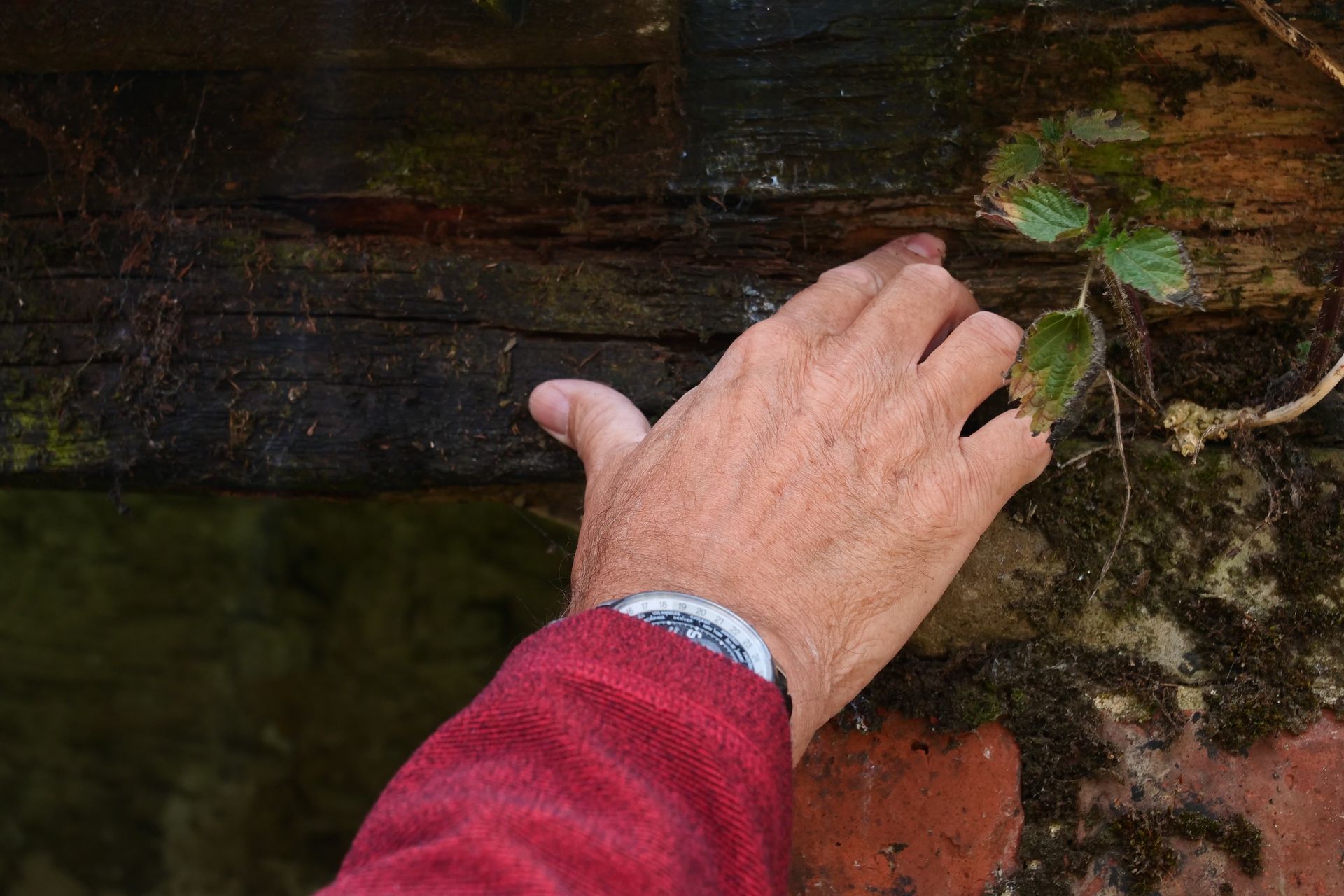
Ferrous metal had been incorporated around parts of the window construction. As iron corrodes, it expands. Within masonry, that expansion can exert considerable pressure on the surrounding stone.
The result here was cracking, displacement and deterioration of the stonework around window heads and associated features.
This looked like serious structural movement. Investigation showed that deterioration of embedded ferrous metalwork was responsible for significant damage to the surrounding stonework.
Some lintels had partially failed and required specialist rebuilding. I made it quite clear that this would be expensive work requiring an appropriately skilled artisan.
There were other problems too. The balustrading to some windows was unsafe because corrosion of its ferrous fixings had damaged the surrounding stone. Cement mortar had also been used where traditional lime mortar would have been more appropriate, contributing to moisture being retained within the walls.
So this wasn't a survey saying:
“Don't worry, there's nothing wrong with it.”
There was plenty wrong with it.
What the survey did was something much more useful.
It separated the defects, considered their likely causes and explained what needed to be done.
The property subsequently sold
And that is the part of this story that has always stayed with me.
The seller commissioned the survey because previous attempts to sell the property had been affected by concerns about its structural condition. My report could then be made available to prospective purchasers.
The property subsequently sold.
The survey hadn't removed the cracks.
It hadn't made the necessary repairs disappear.
And it certainly hadn't told the purchaser that a historic château would be inexpensive to maintain.
What it did was replace a frightening unknown with information.
A prospective buyer could move from:
“The château is cracking up. What on earth am I buying?”
to:
“These are the defects. These are their likely causes. This is what needs repairing. Now I can decide whether I still want the property.”
That is a very different decision.
A surveyor shouldn't be trying to kill – or save – the sale
There is an important qualification here.
It isn't the surveyor's job to make a property transaction happen.
Equally, it isn't our job to find enough defects to persuade somebody not to buy.
Our job is to give the client sufficient independent information to make an informed decision.
Sometimes that means identifying a defect serious enough that a purchaser decides the property is no longer for them.
If an inspection discovers major structural instability, extensive timber decay, a failing roof or another potentially expensive problem, the buyer needs to know.
But quite often our conversation with the client is more nuanced.
Yes, there is cracking, but it appears longstanding.
Yes, the roof needs expenditure, but not necessarily tomorrow.
Yes, there is dampness, but this is a 200-year-old stone house and trying to make it behave like a modern cavity-wall building may cause more problems than it solves.
Or:
Yes, this defect is serious. Budget for it, obtain quotations and make your decision knowing what is involved.
A good survey should distinguish between those situations.
Buyers don't always need us to find the defect
This is particularly relevant with older French property.
If there is a huge crack running through the front elevation, you don't need to be a Chartered Building Surveyor to notice it.
The purchaser has already found the defect.
What they need is someone who can explain it.
Why has it happened?
Is movement continuing?
Are apparently related cracks actually caused by different things?
Does it require monitoring, localised repair, major structural intervention or further specialist investigation?
What might happen if nothing is done?
Those questions are much harder to answer from photographs, an estate agent's reassurance or a statutory diagnostic report.
And answering them can sometimes give a purchaser enough confidence to proceed.
What about the estate agent?
I can understand why some agents are nervous about surveys.
Their job is to bring buyer and seller together and get the transaction completed. They've probably experienced situations where a purchaser was enthusiastic about a property until a lengthy survey arrived containing pages of defects.
But older properties have defects.
A farmhouse, château or village house that has stood for 150, 250 or 400 years is unlikely to emerge from a detailed inspection without a reasonable list of repairs and maintenance.
That doesn't automatically make it a bad purchase.
In my experience, international buyers often become more nervous when they don't understand a defect than when somebody explains it properly.
A survey may therefore occasionally stop a transaction.
But it can also give a nervous buyer the confidence to continue with one.
And don't necessarily wait to make an offer
There is another practical issue worth mentioning.
The French property market can move quickly. If you have found a house you genuinely want, delaying everything while waiting for a survey appointment can carry the risk that another purchaser makes an offer in the meantime.
That doesn't mean the answer is to dispense with the survey.
It means the timing of the survey needs to be considered alongside the purchasing process.
Talk to the agent and your notaire or legal adviser about the appropriate sequence for your particular purchase. Depending on the stage of the transaction, the statutory cooling-off period and any appropriate contractual provisions may also be relevant.
The important thing is not to assume that arranging proper due diligence and securing the property have to be mutually exclusive.
Confidence comes from understanding what you're buying
We've inspected everything from relatively modest village houses to farmhouses, renovation projects, ski properties and châteaux in France.
Sometimes we find significant problems.
Sometimes something the purchaser is worried about turns out to be relatively straightforward.
Usually, particularly with an older property, it's a mixture of the two.
And that's really the point.
A good building survey isn't about producing a perfect house. It's about giving you a realistic understanding of an imperfect one.
If that information causes you to reconsider the purchase, it has done its job.
If it gives you the confidence to proceed with a property that initially frightened you, it has done its job then too.
And occasionally, as that château demonstrated rather nicely, a survey can help sell the property everyone was frightened to buy.
If you're considering buying an older house, farmhouse, château, ski chalet or renovation project in France, MKN Surveyors can provide a Level 3 Building Survey in English before you commit to the purchase.
Call us on 01944 768561 or email matthew@mkn-surveyors.com to discuss the property and the most appropriate timing for the survey.